Testimonies
Voices and stories from the Anchical hamlet
These precious verbatim accounts hand down the living memory of the Anchical hamlet and the village of Valmeinier. Each testimony sheds light on a particular aspect of this local history, from village schools to revolutionary events.
In the heart of the Savoyard Alps, the Les Chryolles hamlet carries in its stones the memory of generations who shaped this mountain landscape. Every farm, every wall tells the story of men and women who lived, worked and loved in this singular place.
Witnesses of the Past

A hamlet family around 1920, in traditional costume
Precious Memories
These faces still speak to us today. They embody the soul of the hamlet, that of a community united by the challenges of the mountain and the beauty of its surroundings. Their stories, passed down from generation to generation, nourish our project of revival today.
Josette's Testimony (excerpt)
« In 1965 all 5 schools of the village of Valmeinier were still open: the one in La Ville, the one in La Combaz — where the Noraz family from Anchical came down every day along the path — the one in La Duchère, the one in Les Mélèzes... It was on Germaine Mullet's initiative that the school in La Ville reopened around 1980. »
Auguste Noraz, summer 2005 (excerpt)
« Anchical is the last high-altitude hamlet to have been inhabited year-round, through the winter. The farms higher up were only Alpine-pasture farms, used in summer alone. Charles's house belonged to the Marcellin family and its construction is said to date back to 1625. »
Charles and Cécile, 2003 (excerpt)
« During the Revolution, the French armies spared Anchical thanks to the welcome given by the Noraz family, but put Valmeinier to fire and sword. The people of Valmeinier had to borrow from Valloire to rebuild everything. A century later, they were still working to pay off that debt. »
Memory of the Land

Engraved Stones
The dates carved into the stone (1732-1839) bear witness to the generations who built and lived in these places. Each inscription tells a story of building, of hope, and of family life.

Historical Archives
The scanned Sardinian map of 1728 is the hamlet's first official cartographic record. These precious documents reveal to us the ancient organisation of the land and the importance of this Alpine community.

Guardians of the Landscape
The residents of days gone by shaped this exceptional landscape. Their everyday actions, their close relationship with nature, created the harmony that we admire today and that we strive to preserve.
Our Mission of Memory
Our Mission of Memory
The Les Chryolles project does not merely restore stones: it revives the soul of a place and honours the memory of its inhabitants.
Every family who stays at Les Chryolles becomes a custodian of this history. They leave enriched by stories, values, and a deep connection with the Savoyard mountains and their traditions.
In this way, the memory of the hamlet lives on, carried forward by new faces, new children's laughter, new stories being written in keeping with respect for the past.
Preservation
Safeguarding the architectural heritage and oral testimonies
Transmission
Sharing stories and values with new generations
Revival
A new social life that respects the hamlet's heritage
« The cross built at the time of the revolutionaries' fire has been found and is currently being restored. A wayside shrine to Mary once stood at the north-west corner of the hamlet: it will be rebuilt in 2026. »
— Mission of Memory
Josette
« In 1965 all 5 schools of the village of Valmeinier were still open: the one in La Ville, the one in La Combaz (where the Noraz family from Anchical came down every day along the path), the one in La Duchère, the one in Les Mélèzes….. They closed one after another. It was on Germaine Mullet's initiative that the Ville school reopened, (around 1980?) »
Germaine Mulet
I find that the hamlet has been very well restored: the materials (original stones, lauzes, lime….), the shape of the farms grouped together as they were in the past, rather than separate chalets. For those who knew it in the old days, it's very faithful and very lovely. I congratulate you, especially as I know it wasn't easy
Auguste Noraz
Anchical: the old hamlet
« Anchical is the name of an old hamlet. It once comprised a good dozen houses, of which only one remains standing today, having been restored by Charles around 1980. It was reached from the valley by a path that ran from Pierre Benoît (La Combaz) on one side and La Ville Dessus on the other. (above the épilobes ski run). The path from La Combaz ran alongside the ruin of Séraphin's house and the present-day house. »
The last high-altitude hamlet inhabited in winter
« Anchical is the last high-altitude hamlet to have been inhabited year-round, (that is, through the winter). The farms higher up were only Alpine-pasture farms, used in summer alone. »
The Marcellin house
« The house of Charles's that we occupy belonged to the Marcellin family (Charles's paternal grandmother). Its construction is said to date back to 1625, according to Charles, who has drawn up a family tree. Is it the building of the farmhouse, or that of the hamlet, that dates back to that year? »
Charles and Cécile Noraz
The French Revolution in Valmeinier
« At the time of the Revolution. 1789: the region was in the Kingdom of Italy. Sardinian, in fact! The French revolutionary armies arrive in the region by way of the Galibier and the Rochilles passes to reach Valloire. They are given a warm welcome. (The people of Valloire were said to be horse-traders, tradesmen, Jews??) They advance on Valmeinier, starting with La Combe. They are properly received by a certain Noraz. They spare the hamlet (which today is the only place with buildings from that period). Climbing back up towards Valmeinier, they meet resistance and put the village to fire and sword. (La Léchère, Valmeinier, Anchical…). Everything is destroyed, and the herds are turned loose on the mountainside. (The people of Valloire are said to have taken them in…) »
The Fire and Its Consequences
« At Anchical, a woman who lived in the hamlet mounts a French soldier, who dies, and she flees towards the Grand Fourchon. She is caught and burned alive. The people of Valmeinier then have to borrow money from Valloire to rebuild everything. A century later, the people of Valmeinier are still working to pay off the debt. It will disappear as a result of the inflation of 1920 …It was almost a form of permanent domination?? ) And so Charles's mother had been placed with a family in Valloire to keep up these repayments »
Family History: Jeanne Baudin
« Jeanne BAUDIN, born in La Léchère, in what is now Charles's house, which then comprised the whole building up to the present-day apartment of François BAUDIN (Charles's cousin, who died in 2000). She came from a family "of girls," with 3 sisters but only one boy, Jean, the only one able to bring in money to pay off the debts, since the father was an alcoholic and quite incapable of paying back anything at all. This Jean went to work from the age of 14 in the coal mines (on the road down to St Michel, near where the road has now subsided) and had children, among them François BAUDIN, from whom we had rented in La Léchère. Jeanne did a great deal of work to pay off the family debts; she was placed with a family in Valloire, then worked for Bernardet (a priest), then in a spinning mill at St Claire (near La Tour du Pin, with nuns). Then she married (Jean Chrisostome Noraz) and was happy to marry into a family free of debt, a rare thing in Valmeinier (this, nearly 140 years after the debts had been taken on!) In 1962/1963, Jeanne, by then a mother herself, left Anchical for good. »
The Houses of Anchical
The Situation in 1939
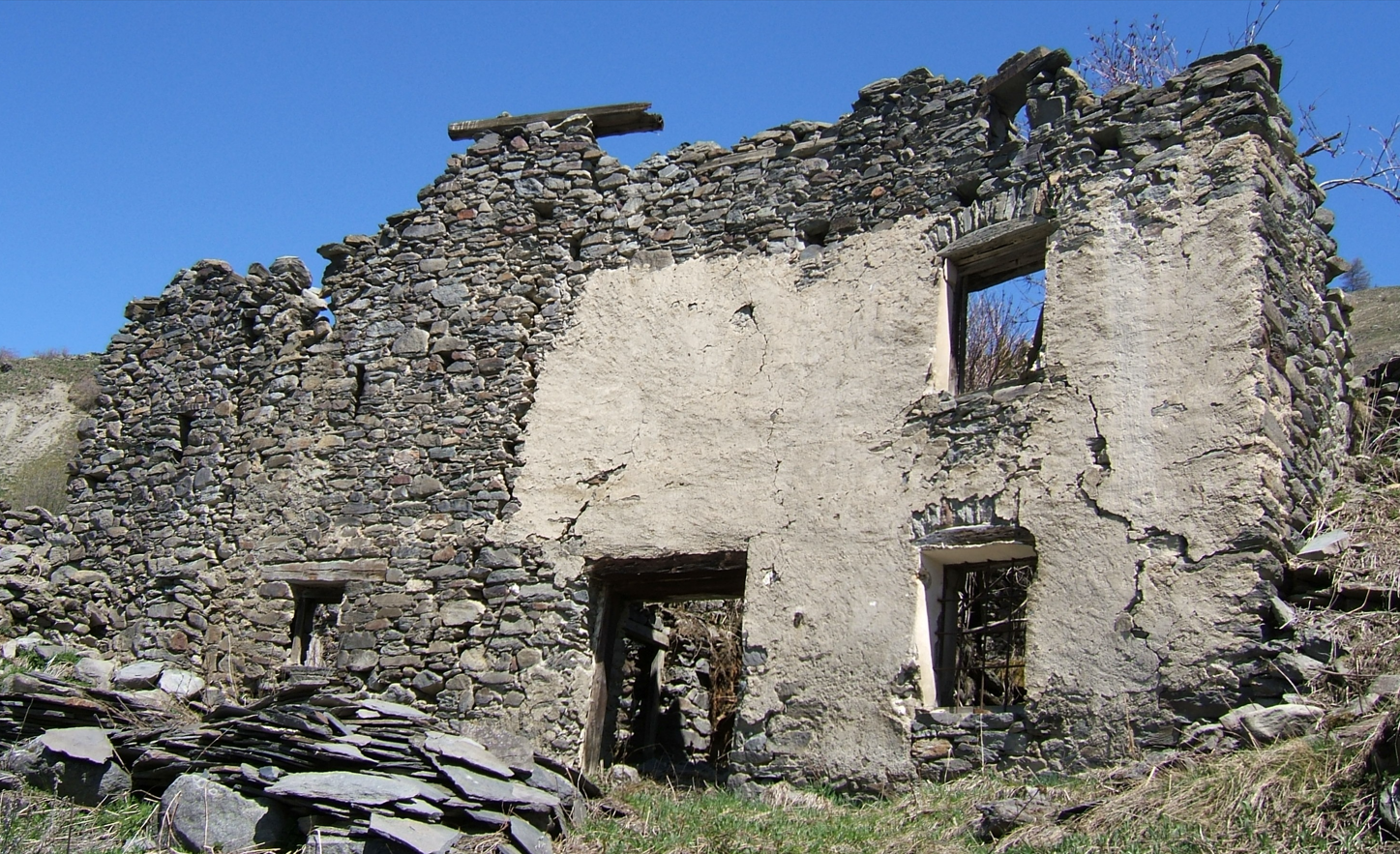
« Charles lived in Anchical in 1939 because Les Combes was overcrowded and the house in Anchical had become free at the time; 4 buildings were inhabited. There wasn't a single derelict building, everything was in good repair »
Hervé Alrbieux
« What I can say is that it's magnificent! The stone and the lauzes make it a village typical of our mountains.
This unusual project put local know-how to work. My father, who knew Anchical well, was so happy to see it come back to life, but, having passed away recently, he didn't get the chance to see the work completed. »
Frédéric Albrieux
« Far from the road and the main path, the village of Anchical fell largely into ruin after the post-war rural exodus. Far from everything, this village was doomed to disappear.
Thanks to the work undertaken, it is coming back to life. The buildings have been rebuilt in their original spirit and blend perfectly into their surroundings. Its access path, which was also gradually disappearing, has been recreated, giving everyone the chance to come here. Built to last, with noble materials, the village can now face the future.
Anchical, which was originally a place to live tied to work, has become a place of pleasure and of contemplating nature. »
Mission of Memory 2025
The Cross of the Revolutionary Fire
Built at the time of the revolutionaries' fire, this historic cross has been found and is currently being restored.
The Wayside Shrine to Mary
A wayside shrine dedicated to Mary once stood at the north-west corner of the hamlet. It will be rebuilt in 2026 to carry on this spiritual tradition.