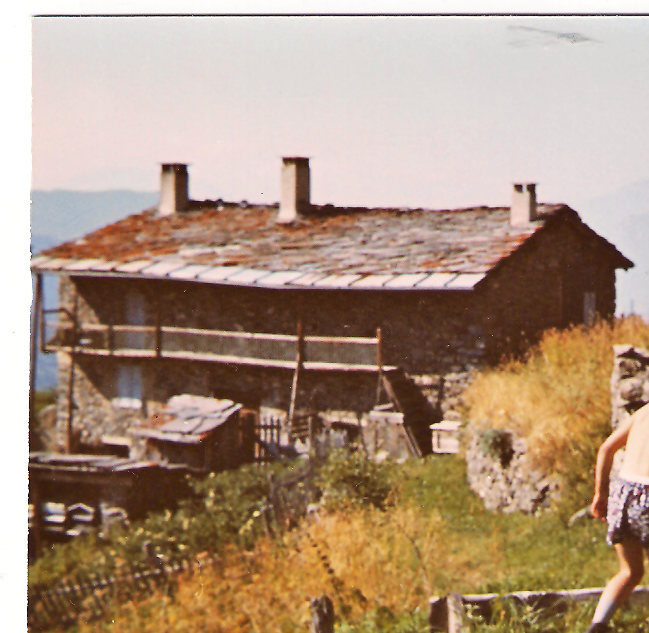
History of the Hamlet
The evolution of the Chryolles hamlet · Anchical, Valmeinier
1732 — 2025
Three centuries of history
From its heyday to abandonment, then to revival — scroll through the story of the hamlet.
- 1732
Sardinian land registry
Every farm in the Anchical hamlet already exists and appears on the land registry.
- 1793
Revolution
Valmeinier resists and is burnt to the ground.
- 1939
The heyday
The hamlet is home to 40 to 50 people: its golden age.
- 1963
The last to leave
Jeanne Noraz, the last inhabitant, leaves her farm. The hamlet falls silent.
- 1985
A first stirring
Charles Noraz begins rebuilding a first farmhouse.
- 1997
The Baud family
The Baud family buys in and joins the revival project. The Noraz apartment received a subsidized Gîtes de France approval for a “Renovated traditional farm dating from 1636; reference: 73G307117”, and the Baud family joined it in 1998 (Gîte 307117).
- 2017
Les Chryolles
The family company “Les Chryolles” is created.
- 2022
Final planning permission
Planning permission is granted after 20 years of proceedings.
- 2025
Revival
The rebuilding works are complete.
The History of Anchical
Once upon a time there was the village of Anchical. During the modern era, the village had two spellings: Anchical and Enchical. According to Adolphe Gros's 1935 dictionary, Anchical would be a man's name of Germanic origin: Engescaldus. In reality, Anchical is a satellite of the village of la Combaz. To understand Anchical, one must understand the village of la Combaz.
Around the year 1000, the villages of les Combes, les Mélèzes, la Ville-Dessous and la Ville-Dessus were already well established. The population was growing and looking for new places to settle. The hamlet of la Combaz sits astride the commune's most important thoroughfare, and it was in this fold of land that the first structures were born. An old legend passed down by the elders tells that the founding of the village of la Combaz is owed to a group of religious men, who took an active part in opening up the landscape to create new farmland.
From the year 1000 to the 14th century, the landscape kept changing to meet people's needs. From the 14th to the 17th century, many areas were built up: Pierre-Benoit, Grange-Bernard, le Châtelard, la Saussette, Buffard, le Chapet, and of course Anchical.
In Anchical, the inhabitants lived there year-round. An oratory was built in the 19th century. The people of Anchical also raised a great wooden cross 4 metres tall — the third-oldest dated cross in the commune: 1816. It is now being rebuilt to its original design.
From the end of the last war onward, the village began to empty out. Starting in 1946, the houses weakened and collapsed one after another. Little by little everything crumbled, giving way to dense vegetation that laid a blanket of green over the old village.
One of the distinguishing features of the village of Anchical is its carved stones. It is the place in the commune with the most engravings relative to the number of houses — clear evidence of a wish to leave one's mark.
— Frédéric Albrieux, historian of Valmeinier's history
The evolution of the Chryolles hamlet: from traditional activity to abandonment, then to rebirth
1629: First Memories of Anchical
Testimony of Auguste Noraz
"The hamlet's first documented memory dates back to 1629, a precious testimony from Auguste Noraz that marks the beginning of Anchical's written history."

Historic Land Register
The 1728 Mappe Sarde, showing the hamlet of Anchical's earliest boundaries.
The Hamlet of Days Gone By
Life in the Hamlet in 1939
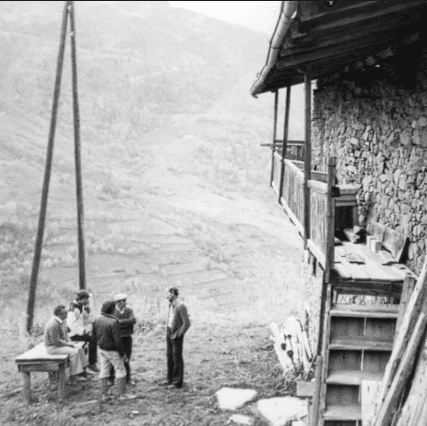
"Men talking outside the Noraz farmhouse"
Valmeinier 1939

Anchical as important as La Ville Dessus
The two hamlets equally important in the commune

The 6 farms of Anchical
Close aerial view from 1939 — the 6 farms, paths, and cultivated terraces
A Living Community
- 6 farms — in permanent operation
- 40 to 50 residents — lived there year-round
- Livestock — cows, pigs and sheep
- Terraced crops — rye, potatoes
Traditional Way of Life
- Self-sufficient life, 365 days a year — farming, livestock, barns, stables
- Coal mine — at Anchical
- Connecting paths — between farms and hamlets
- Summer transhumance — to the high pastures with the young and the herds
The Gradual Abandonment

1950 — The Farms Are Still Standing
The hamlet is emptying out gradually; the terraces are starting to be reclaimed by vegetation.

1970s-90s — The Abandonment
The buildings deteriorate, overrun by vegetation, battered by the weather.
The rural exodus and economic change from 1945 onward gradually emptied the hamlet of its inhabitants.
Causes of the Abandonment
- Modernization of agriculture
- Rural exodus toward the valleys
- Difficult winter access
- Changing ways of life
Consequences
- Farms abandoned one by one
- Deterioration of the buildings
- Landslides, ruins and overgrowth
- Loss of traditional know-how
The Rebirth of the Chryolles

Reconstruction
Restoration respectful of the heritage

Result
The hamlet regains its former splendor

New Life
Comfortable, authentic interiors
Since 1995, the Chryolles project has been bringing the hamlet back to life with respect for its heritage and a social mission.
Restoration
Social Life
Sustainability
“A hamlet coming back to life, where children’s laughter and fireside conversations can be heard once more”